Tuesday, January 3, 2012

Book Review: "Chained" by Rebeca Mojica (or, an obsession was born...)

Other than the few chainmaille/scalemaille pieces that I had tried at GenCon, I started my chainmaille adventure with a sad lack of available patterns. Although chainmaille has been around for centuries, available patterns for jewelry can be a little tricky to come by. Especially since I have been trying to minimize the use of additional accessories such as beads, crystals, and wire. Right now, with a few exceptions, I am interested in seeing how much you can do with just the various metals and colors available in jumprings. Jumprings give the jewelry an intricate feel and give it a simple elegance I really enjoy. Plus, I have enough trouble keeping all my rings straight without adding bead organization to my list of things I have to find the time and space for.

So it was a thrill when I found the book "Chained" by Rebeca Mojica at a local craft store. Rebeca is the owner/founder of Blue Buddha Boutique (http://www.bluebuddhaboutique.com) in Chicago, IL. She is also an accomplished chainmaille artist with her own line of chainmaille jewelry and a chainmaille instructor. Although I have not had the pleasure of taking one of her classes (yet, hoping to change that in 2012), I can honestly say that the rings and supplies I have purchased from Blue Buddha are fantastic and her book changed the way I think about chainmaille.


If you are at all interested in chainmaille jewelry, I don't know how you can NOT be caught simply on the cover of this book. Even though it shows only 2 of the 20+ patterns outlined in the book (the Japanese Cross Pendant and a Coiled Japanese Lace Bracelet), it succeeds in showing the variety of colors, sizes, shapes, and textures available in chainmaille. The book also has a nice 'heft' to it that makes you feel like you are getting your money's worth. The print quality is strong, although I have to admit that after months of opening the book and looking at patterns, the binding is starting to feel a little loose. I think this book would be a great candidate for spiral-binding allowing people to have it open to a specific page for extended periods of time without trying to weight the corners down to keep the book from slapping shut. The table of contents is clear and easy to understand, you quickly understand how the book is organized and what it can offer to you. The pictures of each finished project, as well as the instructions, or full-color and glossy without overwhelming the (all important) text instructions.

This book is a perfect 'beginning mailler' book, but it also has a lot to offer those who have been launching rings across the room for years. The first section of the book outlines a brief history of chainmaille (with pictures of chainmaille armor that exhaust me just looking at the density of the rings), as well as discussing the various characteristics of the most common jumpring materials, care and cleaning of completed pieces, and the all important tool discussion. This book is where I learned about the wonderful product known as 'Tool Magic'. Since I've started using this product on my pliers, I have lost far fewer rings to the infamous 'slingshot' effect (you know, when you lose your grip on the ring and hear it ricochet off the wall across the room?). There is also a clear in-depth discussion of the appropriate ways to open and close jump rings and how to salvage warped rings (what Rebeca calls the chicken dance technique). All of these are invaluable tips for a beginning mailler, but even an experienced jewelry creator can benefit from Rebeca's discussion of choosing the appropriate clasps and embellishments for your pieces and fantastic finishing touches to give your jewelry that stand-out quality necessary if you are looking to sell you pieces (or even are just a glutton for compliments like me).

The patterns in the book are divided into 4 main families (Japanese weave, Byzantine weave, Helm weave, and Rebeca's coiled mail designs), and then within each of these weaves there are patterns ranging from beginner level to expert. Each pattern is rated by difficulty (which is fantastic, and in my experience the ratings are very accurate), but each pattern also has an estimated time committment listed. This allows you to determine approximatly how long the project will take you to complete (from under an hour to epic-level projects that take 6 or more hours). And many of the patterns also have variations listed (such as how to make the earring pattern into a bracelet or the necklace into a multi-strand cuff bracelet). The pictures are clear and the directions are easy to understand. Having made most of the items listed in the book (I haven't experimented with the coiled patterns yet), I have rarely had any difficulty even if it was the first time I was making a particular weave. The directions for the Byzantine chain were the clearest I have seen in quite some time.

The one characteristic of the book that may cause some difficulty for maillers, especially if you chose to not use Blue Buddha as your ring supplier, is Rebeca's shorthand for ring sizes/gauges. She doesn't use the more standard '5/16" 18-gauge' description, but has developed her own ring classification using an alpha-numeric system that describes rings with terms such as 'D20'. The letter indicates the inner diameter of the ring, while the numbers indicate the gauge. Blue Buddha uses this alpha-numeric system on their website, but if you use other ring suppliers you will have to convert the descriptions to determine what rings you need. This can be time-consuming if you are looking to order supplies for a variety of projects. However, this naming convention has saved me a ton of space on my ring container labels...

As you can imagine, in any book that involves lists of numbers and ring sizes, there are some mistakes/errata in the book. However, as errata are discovered Rebeca lists them on the supply page for the book on Blue Buddha's website ('Chained' errata and updates) along with the correction. I simply went through my book, compared the identified errata, and wrote the corrections in the appropriate place. If you notice errors while you are doing a project, you can e-mail or call Rebeca or Blue Buddha and inform them, their contact information is easily obtainable in the book or on the website (which is refreshing).

Overall, this book would be a great gift to any accomplished or aspiring chainmaille artist to help them expand their horizons, develop a full understanding of a variety of weaves, and experiment with variations on classic chainmaille techniques.  It's probably available at your local book store, but you can also check out Blue Buddha's website to purchase a copy.  I've also seen it available as an e-book on the Barnes and Nobel Nook Bookstore.  Pick it up where you will, but you can't have my copy...

Friday, December 2, 2011

In the Beginning...(or, How I started mailling)

I'm enough of a fantasy/sci-fi nerd that I had heard of chainmaille and scalemaille before (in the context of 'woot, my level 14 paladin just found new scalemaille pants!), but I'd never dreamed of doing anything like it myself. The few pieces of armor I'd seen were INTENSE, thousands upon thousands of rings each woven into the pattern by hand, hundreds of hours invested into a piece of clothing that weighed a ton and would succeed in making you the coolest person at the Ren Faire but the weirdest person on your block. Days at a table with a pair of pliers and a magnifying glass? Yeah, sounds like a blast (insert sarcastic tone and eye roll hear). I blame my friend Kathy, a local craft store, a dedicated chainmaille artist, and a wonderful annual trip to an event called GenCon for changing that attitude and launching my addiction to tiny jump rings, multiple pairs of pliers, and desk lamps with built in magnifying glasses...

My husband and I, along with a group of friends, have traveled to GenCon every year for quite some time now. If you are at all into gaming (card games, board games, computer games, role-playing games, console games, etc.), you may have heard of GenCon. It is THE place to be if you want to experience 24-hours straight of gaming goodness while also allowing the release of that inner nerd we all have buried deep inside us. They have discussion panels, thousands of different games, hundreds of vendors, and a nice variety of crafting classes. Many of these are of the 'build your own foam weapon or leather breastplate' variety, but several years ago Kathy decided to take a class focused on making a chainmaille dicebag. Every good gaming nerd must have a trusty dicebag to keep those 3-sided, 6-sided, 8-sided, etc., etc., etc., dice in, after all. Eventually Kathy had created several dicebags as well as a lanyard to wear her GenCon badge in style. I loved what she had done, so the next year I decided to take a class as well, but (being a glutton for punishment and just a smidge competitive) I decided to 'take it up a notch'. Chainmaille dicebag (pffft), I decided to go straight to scalemaille.


Scalemaille could be considered the angry big brother of chainmaille. You don't just weave the rings, but you also attach metal scales to the rings themselves. My bag wasn't pretty (being that it was all in unanodized (plain) aluminum), but to this day it gets many oohhhs and ahhhs from people when I place it on the table. Plus, I figure it doubles as a weapon since you could really leave a mark if you decided to wack someone with it! Making this bag involved many hours of time (and more than a little inappropriate language), but I enjoyed the challenge and the final product, and though 'hey, I'll try something like this again'. But life dictated that I wouldn't have another chance to touch my rings for a year.

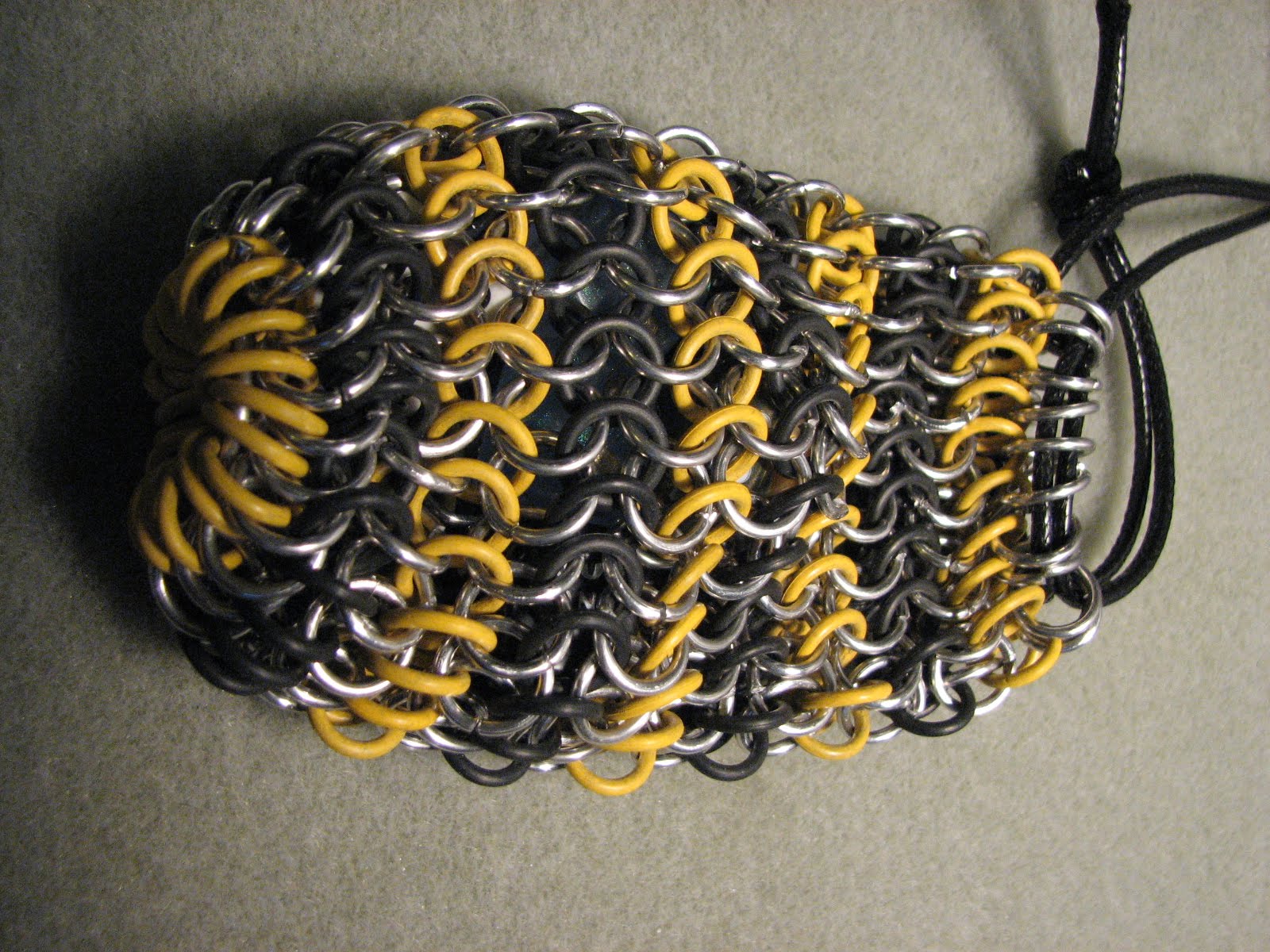
For this year's GenCon I decided I was going to take several chainmaille classes, as I had finished school and had more free time to take up a hobby. Since a good D20-playing nerd can never have too many bags of dice, I chose to create a rubber/metal ring dicebag, and then to try something more 'wearable' I picked the 'Create a Chainmaille Ring' class. My husband was rooting for the 'Chainmaille Bikini' class, but I (naively) thought that if I didn't finish the project at GenCon I might never finish, and that is a mega-project. The dicebag was a straight-forward project, European 4-1 weave with aluminum, black, and yellow rubber rings. I was able to finish it within the time-frame of the class, which was what I was looking for.


Then...there was the ring...my first venture into the wonderful world of micro-mailling... My previous 2 projects had used fairly standard (larger) size rings, but that was not an option for something that had to be very flexible to be worn on a finger. So the rings used in this project were less than 4 mm across, which you can't truly appreciate until you try to hold them in a pair of pliers and match the ends of the openings up exactly. It took me 4 hours to put this little ring together, and there were (almost) some tears involved. But in the end, I had the first piece that I could wear and show to people without having to explain why on earth I needed a specific bag for dice... Since the ring (mis)adventure, I've worked with many jump rings as small or smaller than what was used in this project, but at the time all I could think was, 'what kind of crazy person does this by choice'.


That was around 3 months ago, and since then I have taken over the desk in our spare bedroom (with dreams of a desk in my reptile room (long story on that room), have multiple containers of rings of all sizes and colors, and a dedicated album of photos on my Facebook page showing my latest jewelry creation. As my husband would say, 'this escalated quickly...'.

I can't even remember now what I wandered into Hobby Lobby looking for that fateful day (picture frames, I think...), when I saw the book CHAINED by Rebeca Mojica (founder/owner of Blue Buddha Botique, )on the shelf. I'll admit it, flipping through I got caught up in my 'I like shiny things' personality, and a purchase was made. And the rest, as they say, is history. I'll talk about projects I've worked on in future posts, but suffice to say since that first pattern book purchase, I have made many earrings, pendants, necklaces, bracelets, etc., and have added countless jump rings and many more patterns to my collection. I've had people try to ply me with alcohol to talk me out of my current accessory, I've had many late nights thinking 'just a few more minutes and this project is done', and I've loved every minute of it. Who would have thought something so potentially frustrating could also be so fulfilling? Now, if I could just learn to control the swearing...